The Boeing Cascade Climate Impact Model focuses on the strategies with the greatest potential to reduce aviation emissions. While the manufacturing lifecycle is difficult to capture comprehensively, reputable independent studies point to the same conclusion: nearly all emissions come from burning fuel, not building the aircraft.
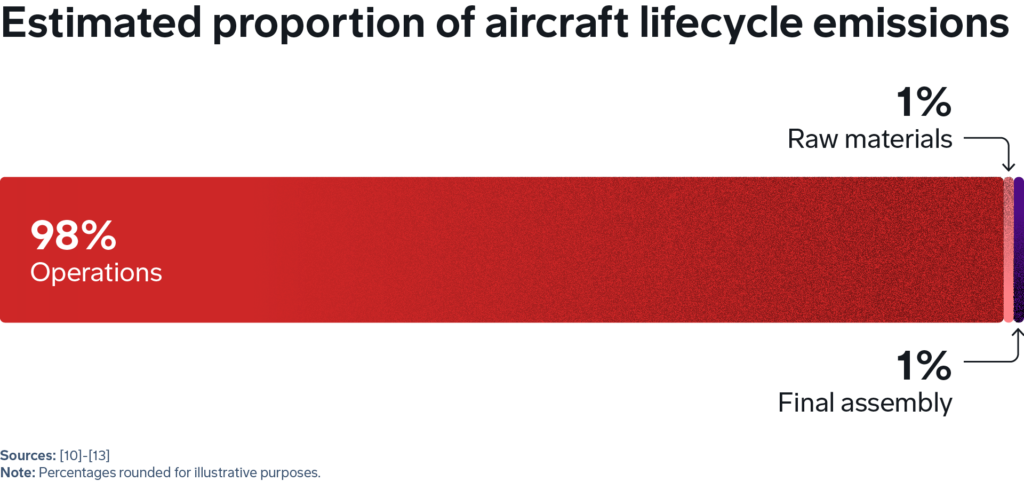
The manufacturing-related figures shown above are conservative estimates, meaning the real proportion is likely lower. Internal Boeing analysis suggests final assembly emissions could be as little as 0.006% when using factory-level data, or approximately 0.3% when using reported Scope 1, 2 and 3 emissions (see data methodology section).
The bottom line: Although manufacturing aircraft does release a marginal amount of emissions, these are quickly offset by the efficiency gains of operating newer aircraft.
Data methodology
Let’s evaluate a typical single aisle assembly facility. The Renton, Washington facility serves as Boeing’s dedicated final assembly site for single-aisle 737 family airplanes, producing Next Generation and 737 MAX–based models and is also the production site for 737 wings and landing gear. Operations at the facility include machining, part assembly, primer, topcoat and specialty coating application, solvent cleaning, facilities and equipment maintenance, and other support activities. A typical assembly sequence is as follows: installation of insulation material, interior walls, wiring and plumbing in the fuselage; installation of the landing gear and wings; attachment of the tailfin; installation of floor panels and the service galley; functional testing of hydraulic and electrical systems; completion of the interior including lavatories, overhead bins, ceiling panels, carpets, seats, and other essentials. Finally, jet engines are attached, and the aircraft is painted. The airplane then undergoes functional testing on the flight line, followed by its first flight.[1]
To characterize the assembly process of a 737-800, the total electricity, natural gas, and water consumption at the Renton site for 2017 and 2018 was compiled. Boeing reports criteria air pollutant volumes in a Puget Sound Clean Air Agency (PSCAA) emissions statement. Volumes of criteria air pollutants during these years were collected from those statements; however, only species above a 25 tons-per-year reporting threshold are included. These years were chosen because they are the last two years when the 737-800 was the dominant aircraft in production at Renton.
Other sub-models produced during these years included the 737-700, 737-900ER, and the 737 MAX. To allocate impacts among sub-models, total aircraft deliveries during that time[2] were multiplied by the operating empty weight (OEW) of each corresponding aircraft. Operating Empty Weight (OEW) is the weight of the aircraft structure, powerplant, furnishing systems, unusable fuel and other unusable propulsion agents, and other items of equipment that are considered an integral part of a particular airplane configuration. Also included are certain standard items, personnel, equipment, and supplies necessary for full operations, excluding usable fuel and payload. At the time of this writing, the OEW value for the 737 MAX had not yet been published; however, OEW values for the other sub-models produced during the study years can be found in the “737 Airplane Characteristics for Airport Planning” document. [3]
Total utility and emissions-to-air data were divided by the total weight of aircraft delivered in the same years. Finally, this allocated inventory data was multiplied by the OEW of the 737-800; the results are shown in Table 1.
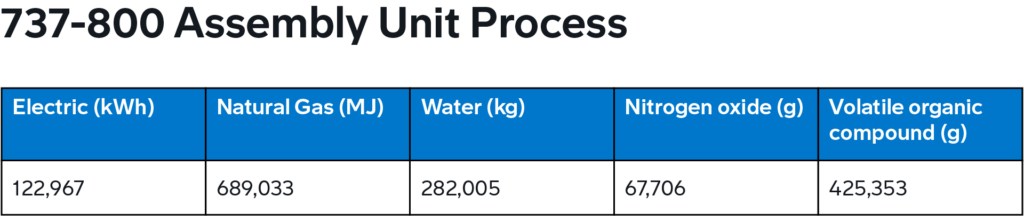
However, for illustrative purposes a nominal GWP value can be calculated from the unit process above and the NWPP eGRID emission factor of 305 g CO2e/kWh (632 lb CO2e/MWh) for electricity[4], and the EPA emission factor of 50 g CO2e/MJ (53 kg CO2e/MMBTU) for natural gas.[5] Using these factors this equates to roughly 40 tonnes CO2e for the assembly process.
Using data directly from Cascade[6] the in-service GHG emissions phase of a typical single-aisle product is approximately 27,500 tonnes per year which over an average lifetime of 23 years[7] is 634,000 tonnes. Based on these data the emissions associated with final assembly account for approximately 0.006% of in-use emissions.
Assembly of the aircraft is only part of Boeing corporate footprint. An alternative method to determine the emissions footprint of manufacturing as a proportion of in-use emissions is to look at Boeing’s reported data. Looking to Boeing 2025 Sustainability Report[8] page 34, the combined Scope 1 and Scope 2 (locations based) emissions are 1,300,000 Metric Tons CO2e, compared to the total 373,000,000 Metric Tons CO2e Scope 3, category 11- use of sold products (352,000,000 of which are from commercial aircraft). Using this method Boeing’s Scope 1 and 2 emissions represent 0.3% of GHG emissions.