

Why it matters
No one can predict how technology and policy will shape aviation’s path to decarbonization. Scenarios help broaden thinking about what’s possible — and what’s required — by exploring different combinations of strategies under real-world constraints.
What scenarios do
Cascade offers a collection of ready-made scenarios for each strategy – traffic, aircraft, operations, energy, and offsets & removals – which are combined in unique ways to form overall scenarios. These represent different levels of ambition and demonstrate what outcomes may be achieved from industry action, such as deployment of specific aircraft or fuels. Depending on the industry report, not all scenarios reach net zero — some reflect current trends or moderate progress, while others show what would be required to achieve it.
They can be accessed on a new dedicated page for browsing, selecting, and managing scenarios.
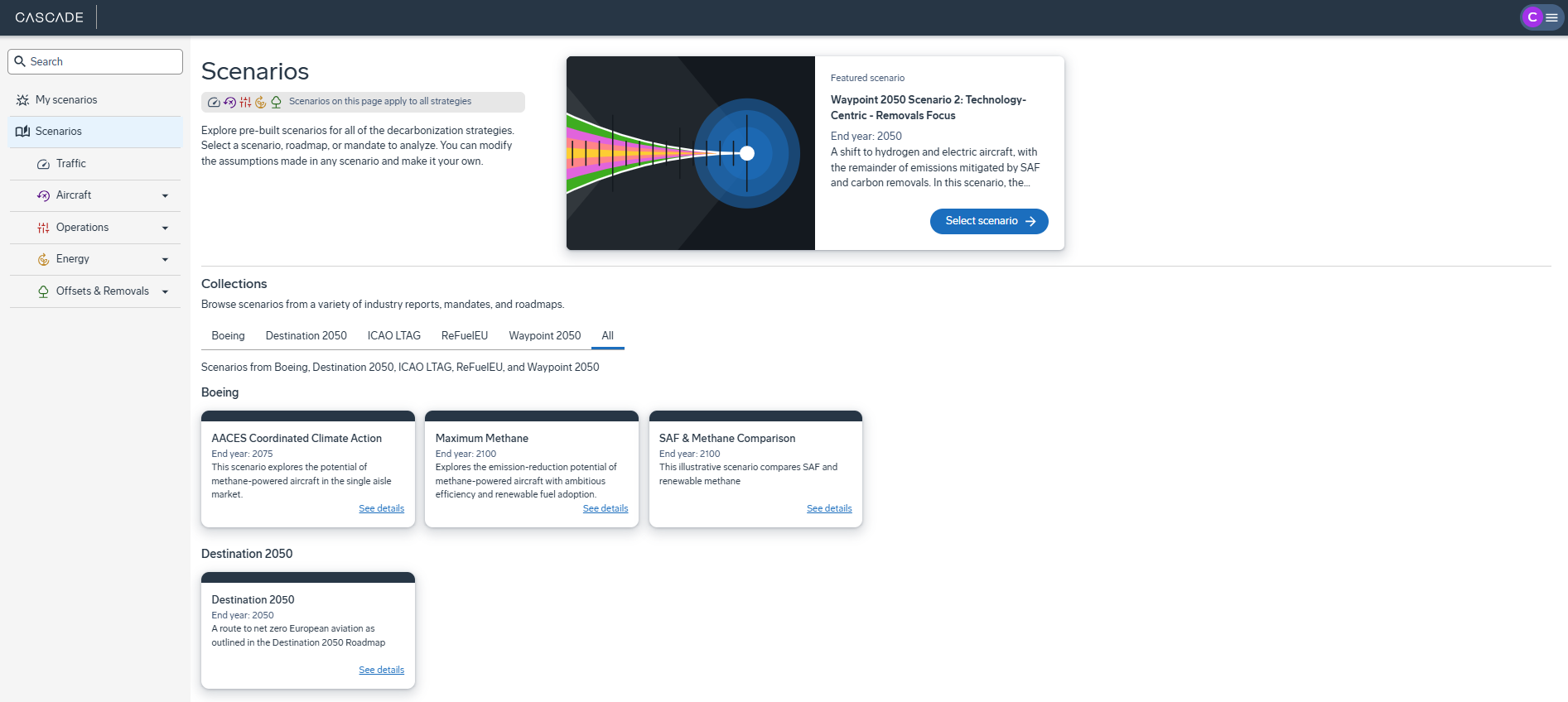
What scenarios are available?
Waypoint 2050
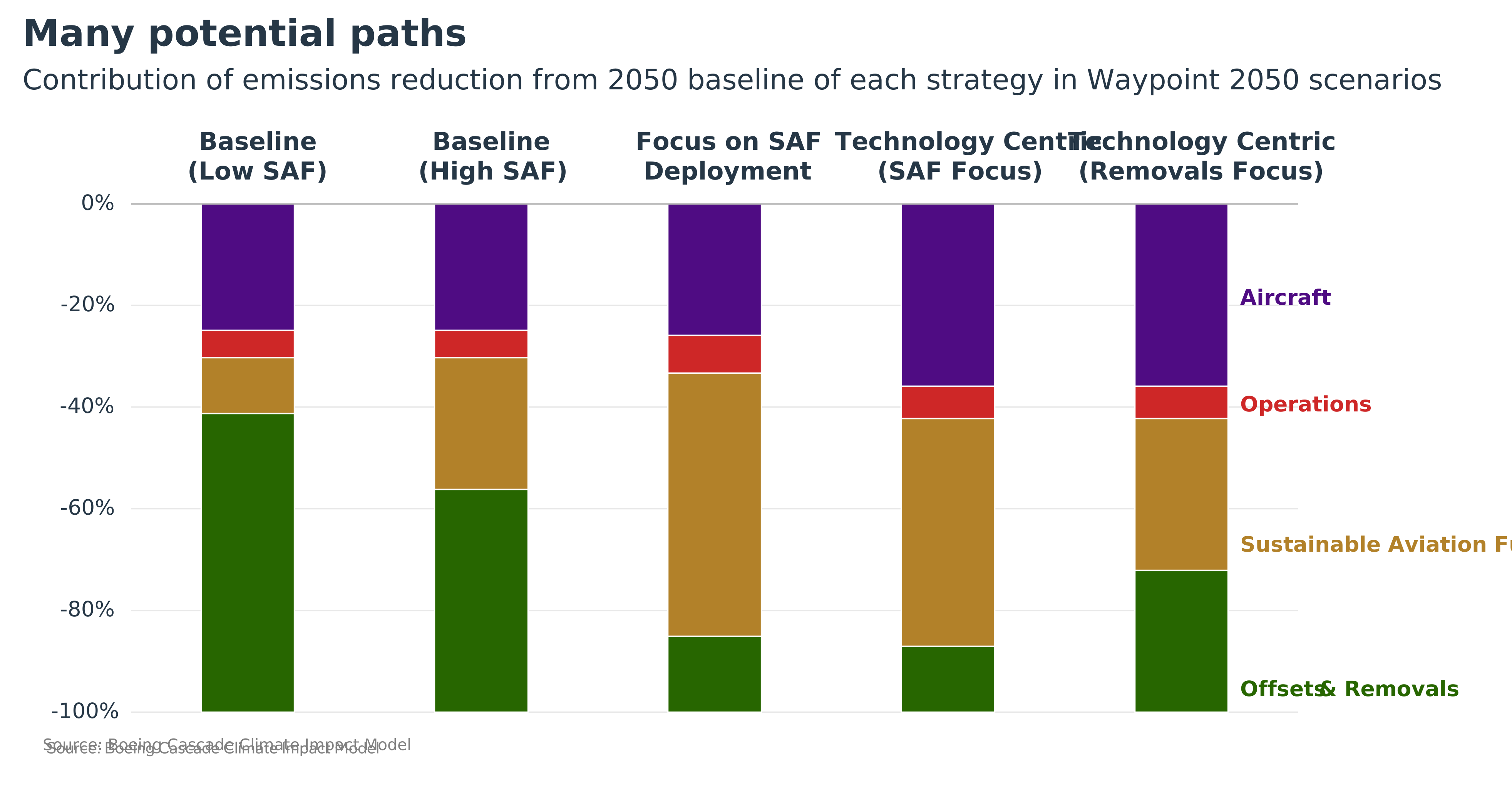
The Air Transport Action Group’s Waypoint 2050 report, revised in 2026, is one of the premier resources for aviation’s path to net zero in 2050 due to its rigorous technical evaluation. These scenarios span a range of ambition levels across strategies, resulting in vastly different emissions reduction contributions from each.
IEA World Energy Outlook
Electricity scenarios were adapted from the IEA’s World Energy Outlook, which assess the outlook for electricity by source under different policy scenarios. These scenarios are:
- Stated Policies: shows electricity generation that meets current policies
- Announced Pledges: analyzes the potential outcome for the energy sector if all climate objectives set by governments are achieved
- Net Zero Emissions: shows a potential pathway for the global energy sector to achieve net zero CO2 emissions by 2050, with advanced economies reaching net zero emissions in advance of others
ICAO Long Term Aspirational Goal (LTAG)
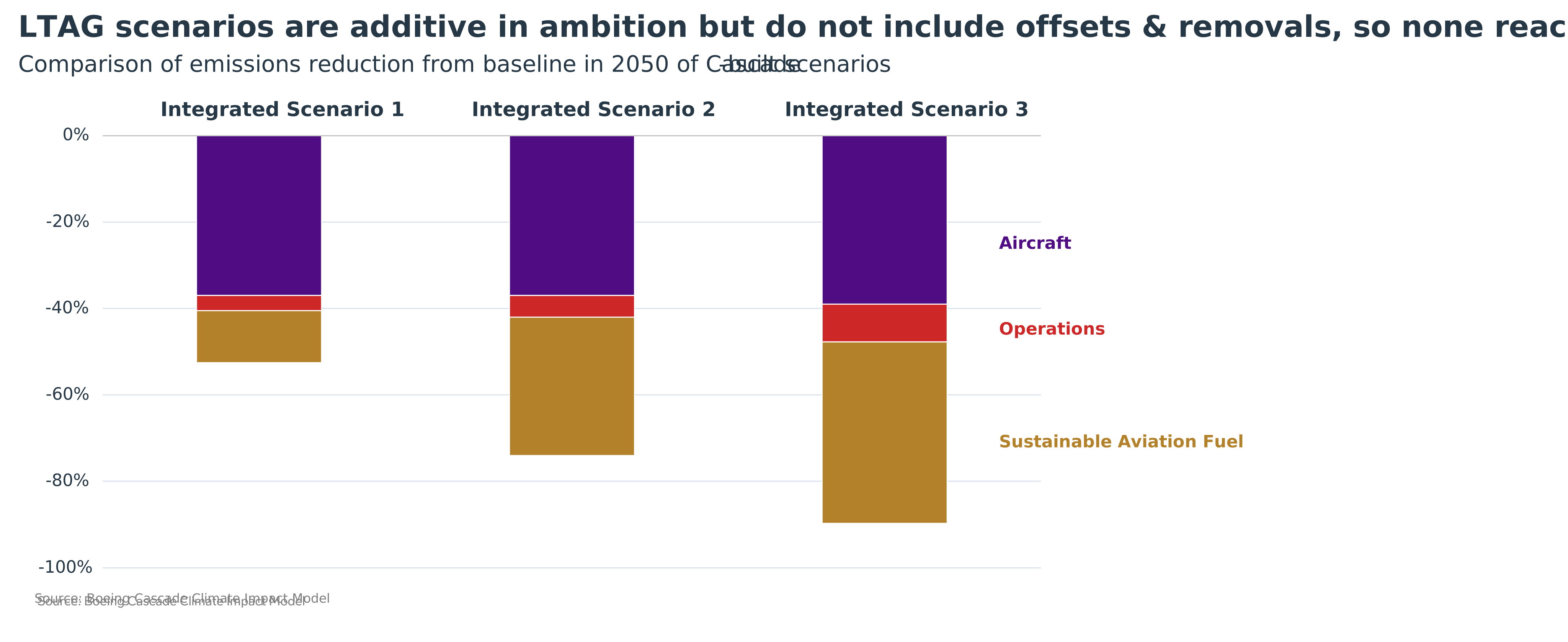
In 2022, ICAO produced a “Report on the Feasibility of a Long-Term Aspirational Goal (LTAG) for International Civil Aviation CO2 Emission Reductions.” In Cascade, we have visualized the 3 integrated scenarios found in the report to provide a range of views on the trajectory of emissions for international aviation.
Regional scenarios
Two Europe-focused scenarios have also been added. The Destination 2050 Roadmap outlines a pathway to net-zero emissions for Europe, including the European Union (EU27), the United Kingdom (UK) and the European Free Trade Association (EFTA). ReFuelEU represents the SAF mandate for flights within and departing the EU, including the overall SAF requirements and sub‑mandates that apply specifically to eFuels.
Why were these scenarios adapted for use in Cascade?
Visualize what is required to achieve the scenarios
With Cascade’s plot options, it’s possible to see the energy and fleet required to meet each scenario. For example, let’s look at the amount of biomass needed to make the SAF required for the “Waypoint 2050 Focus on SAF Deployment” scenario:
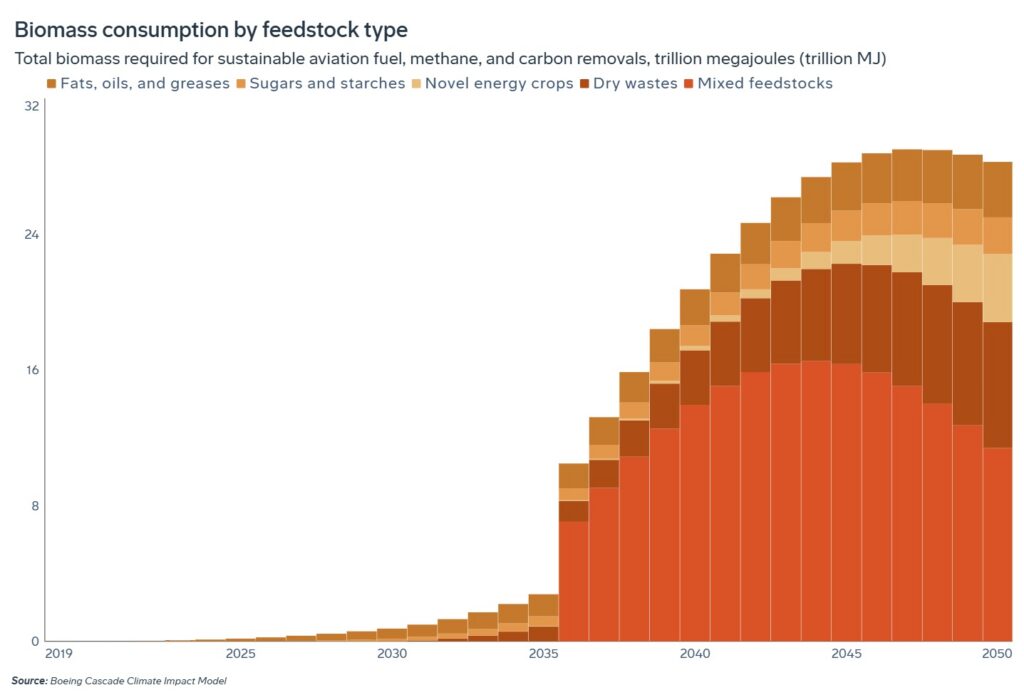
Approximately 28 trillion megajoules (MJ) of biomass will be required by 2050 in the scenario.
Conduct what-if analysis from scenarios
Another benefit of the industry scenarios in Cascade is the ability to use pre-defined assumptions as a starting point to modify further and see the impact on emissions reduction. For instance, the “Focus on SAF Deployment” scenario assessed above assumes that SAF is produced using 100% renewable electricity and green hydrogen. What if the “IEA Announced Pledges” electricity scenarios is assumed instead?
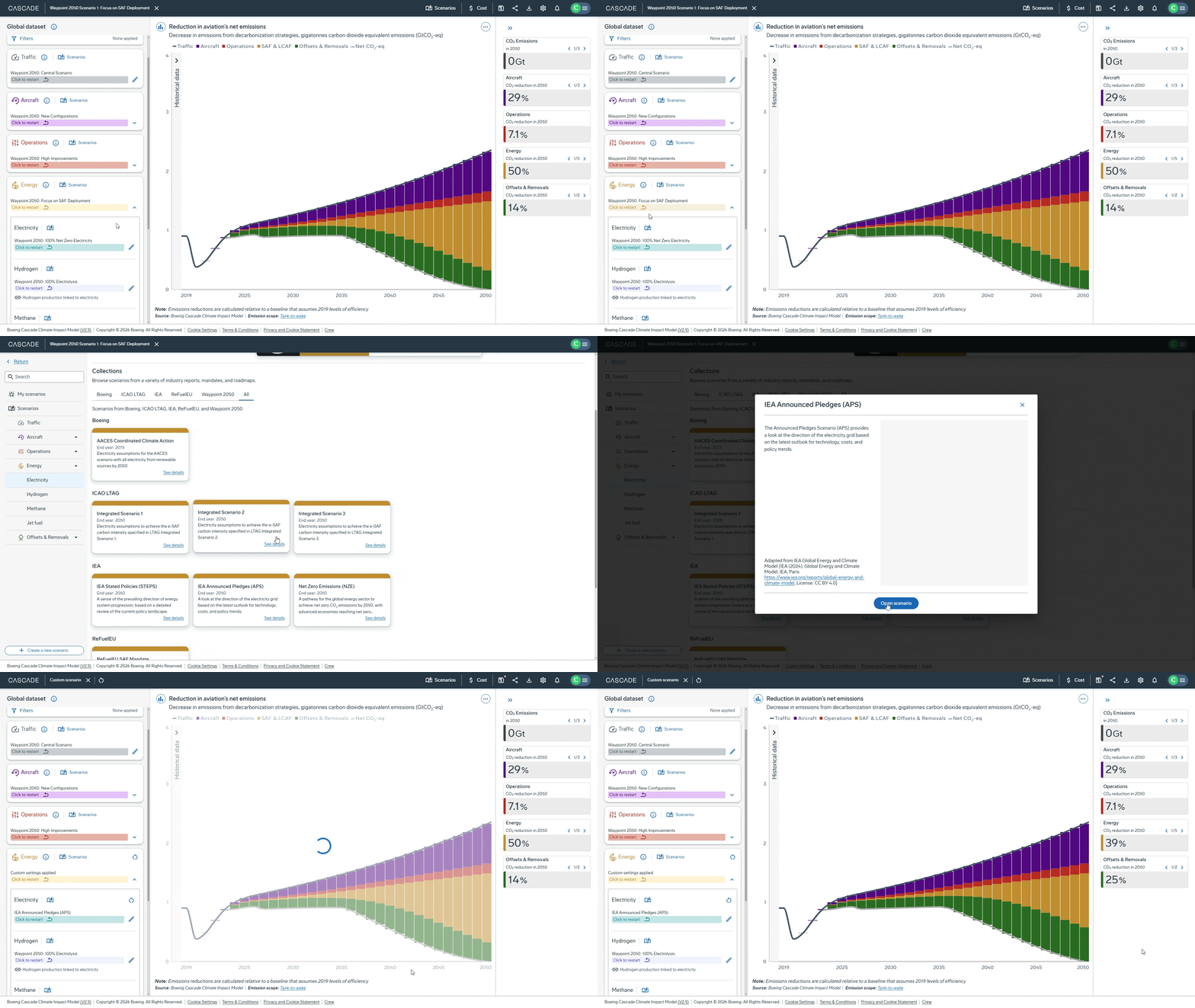
As seen above, the emissions reduction contribution of SAF in 2050 drops from 50% to 39%. Clearly, renewable electricity is critical for maximizing the potential benefit of SAF.
Try It Out
With Cascade, a wide range of scenarios can be examined. For example, by comparing “Technology Focus (SAF Focus)” and “Technology Focus (Removals Focus),” the user can see the importance of new aircraft technologies and airspace operations.
Learn how to use Cascade to create your own scenario.
Curious about the underlying assumptions of each scenario? Read our technical documentation.

