

Why it matters
New aircraft technology is one of the most powerful levers to reduce aviation’s climate impact. The ability to adjust the performance of different future aircraft – whether powered by conventional jet fuel, hydrogen, methane, or electricity – is critical for assessing their potential impact on reducing emissions as their applicability varies by size class.
What the aircraft strategy does
The aircraft strategy has two parts: fleet renewal, which replaces older aircraft with their latest-generation equivalents, and future aircraft, which introduces entirely new types powered by different fuels that aren’t yet commercially available.
Fleet Renewal
Fleet renewal controls how quickly older aircraft exit the fleet and are replaced by the latest generation already in production — for example, replacing a 737-800 with a 737-8 or an A320ceo with an A320neo.
You control the phase-out time: the number of years between the end of production for an aircraft model and the last one leaving the fleet. Shorter phase-out times mean faster renewal and greater fuel efficiency gains from the newer aircraft.
Future Aircraft
Future aircraft are types not yet in service. You define their energy efficiency, range, entry into service year, and production rate, and the model calculates how they enter the fleet over time.
The following aircraft types are included in Cascade:
- Advanced Conventional: powered by jet fuel (fossil-derived conventional jet fuel or SAF), incorporating next-generation technologies that reduce fuel consumption
- Hydrogen: powered by liquid hydrogen fuel, directly combusted in a jet engine
- Methane: powered by liquefied methane fuel, which can be sourced from biomass, fossil, or electricity-based production
- Electric: powered by electricity stored in batteries
For these aircraft, assumptions can be defined for the following market classes:
- Regional: small aircraft with roughly 20-100 seats, designed for shorter flights serving regional and domestic routes (includes both regional jets and turboprop aircraft)
- Single Aisle: mid-sized aircraft typically ranging from 100-250 seats, used for both short-haul and medium-haul flights like the 737 Family, A320ceo/neo, and A220.
- Widebody: larger aircraft typically ranging from 200 to 500 seats, designed for long-haul flights
- Freighter: cargo aircraft
Zoom in
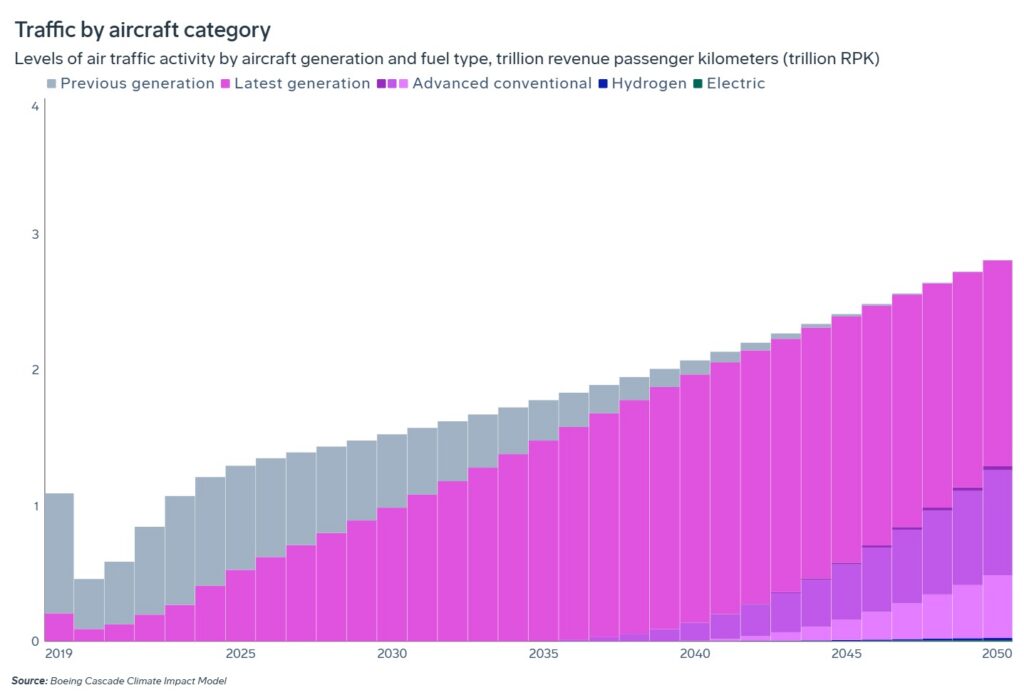
Not only is the emissions impact of aircraft assumptions visible in the main net CO2-eq emissions chart, but the resulting share of traffic carried can be examined in the available capacity by aircraft chart. This chart includes not only future aircraft, but also previous and latest generation.
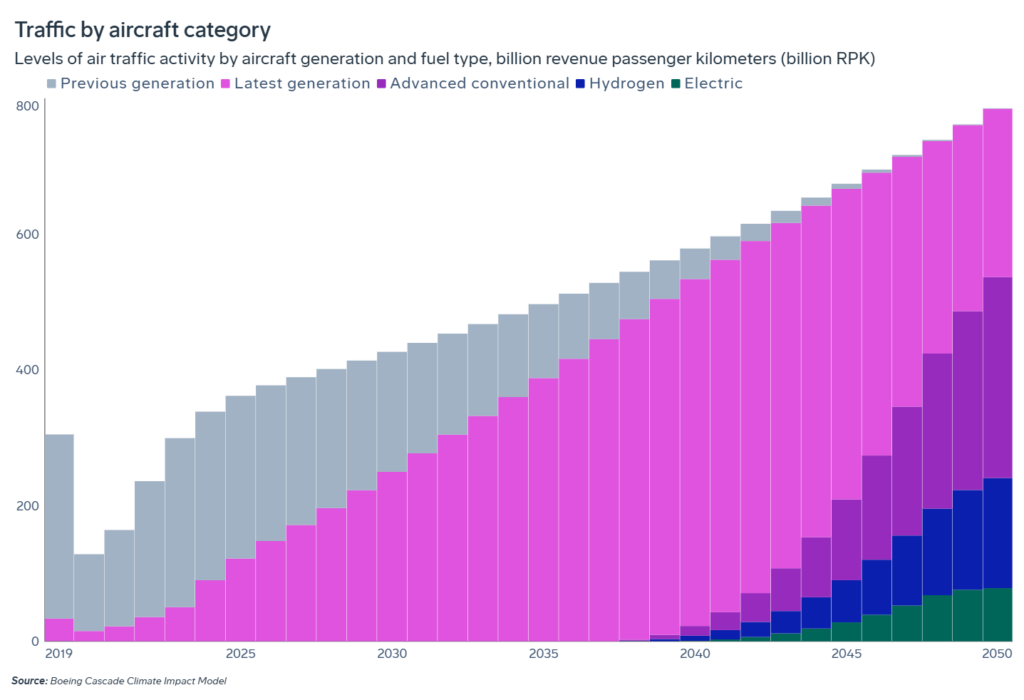
When filtering on just regional aisle aircraft, the share of traffic serviced by hydrogen and electric aircraft increase in this scenario.
Traffic by aircraft type can also be broken down by flight distance.
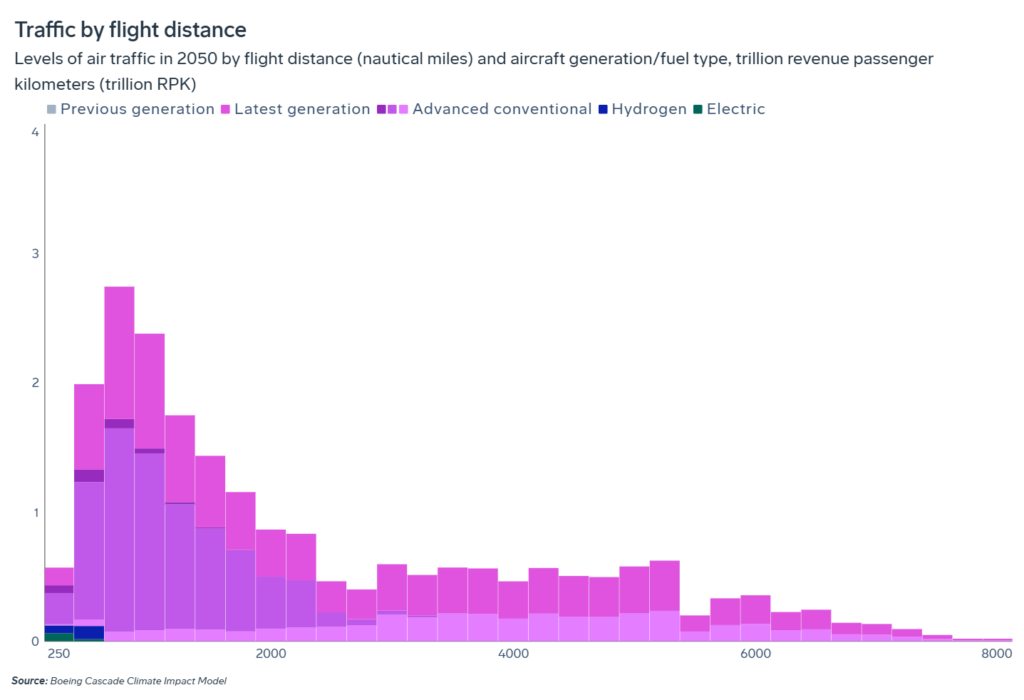
Here, since hydrogen and electric single aisle and widebody aircraft do not enter service, they are limited to below 500 NM.
Try it out
With Cascade the user can start from this technology-centric Waypoint 2050 scenario and understand the potential impact of electric and hydrogen aircraft on different parts of the fleet.

