

Sustainable aviation fuel (SAF) is currently the leading alternative to conventional jet fuel. Alongside carbon removals, it’s an essential strategy to decarbonize aviation.
So why look beyond SAF? Today, most SAF is made from feedstocks that are limited in how well they can scale. And the most abundant ones – like wastes, residues, and electricity – are also the most expensive to convert into SAF.
That raises the question: what other cost-effective, alternative fuels could power aviation in the future?
To answer this question, Boeing evaluated over 50 fuels on their safety, airplane performance, scalability, and infrastructure impacts, among other metrics. From this study, a small number of alternatives emerged:
- Batteries have been explored, but are not currently viable for aviation at scale due to range limitations.
- Hydrogen has become the most widely discussed option after SAF. It is often seen as having strong potential, but would require entirely new aircraft and new infrastructure.
- Methane1 is the less familiar option. Like hydrogen, it needs to be liquefied to be used onboard an aircraft, requiring new technology and new designs. Unlike hydrogen, it can be produced using some of the same biomass feedstocks as SAF and leverages extensive existing natural gas infrastructure.
Powering airplanes with methane would be a challenge but could unlock new opportunities. This is why methane is emerging as a serious option for research and technology investment. In this article, we compare how it performs against SAF and hydrogen across several key areas.

1. More efficient: Methane produces more usable fuel from limited resources
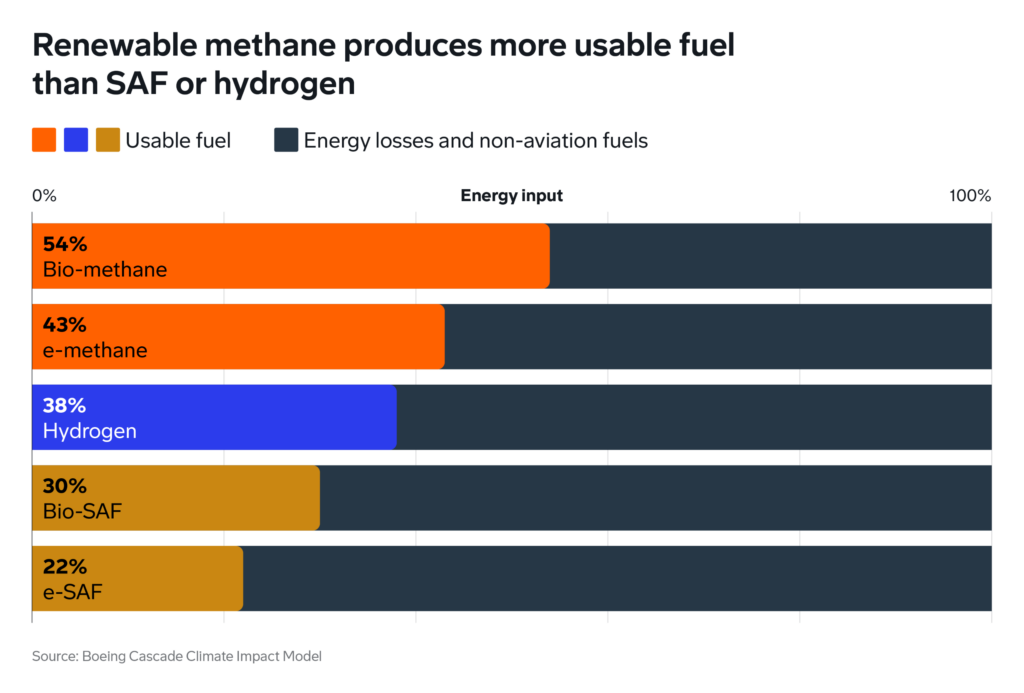
For biomass pathways, significantly more bio-methane can be produced than bio-SAF for the same amount of energy input. This is because methane is the simplest hydrocarbon to make – a single carbon atom surrounded by four hydrogens – and it can be made in fewer steps with fewer co-products. One of the most used biofuels is renewable methane, which is produced globally in municipal waste facilities and farms using anaerobic digestion.
For electricity pathways, hydrogen is the most efficient fuel to produce initially. But once the energy needed to liquefy, store, and transport each fuel is included, e-methane becomes a more efficient fuel to produce.
This makes methane a strong middle ground between SAF and hydrogen – more efficient to produce than SAF, easier to handle than hydrogen.
2. More widely available: Methane can use existing infrastructure
Methane benefits from an established worldwide network of transportation and distribution infrastructure. This makes it one of the most competitive emerging fuel options from a global infrastructure perspective.
Airport infrastructure would still need to be developed and operational challenges associated with handling cryogenic fuels remain. But compared to hydrogen, methane faces fewer infrastructure barriers.
3. Comparable lifecycle emissions: Renewable methane can reduce emissions as much as SAF and hydrogen
Like SAF and hydrogen, the carbon intensity of methane fuel depends on the method used to produce it. The full lifecycle of the fuel has to be considered to ensure emissions reductions are achieved.
Methane and hydrogen both act as potent greenhouse gases when they leak from the supply chain into the atmosphere – commonly referred to as fugitive emissions or vapor loss. The emissions reduction potential of both fuels depends on preventing such leaks. To learn more, check out the explainer: ‘How do fugitive emissions affect the climate case for alternative fuels?’.
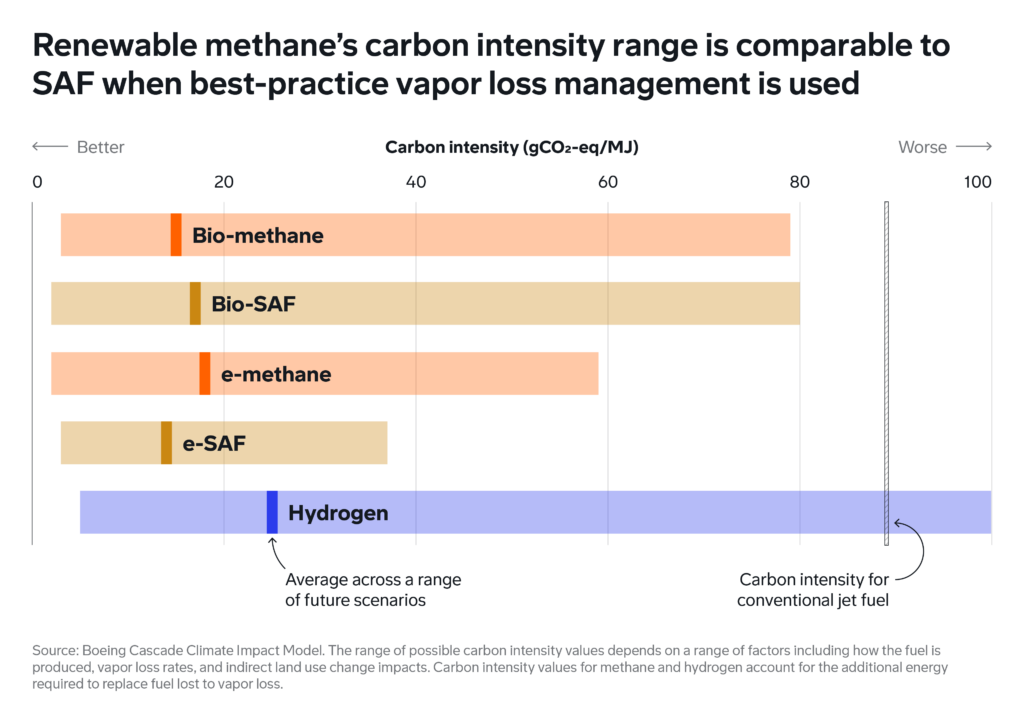
Using today’s best practices for leak prevention, renewable methane would have a similar carbon intensity to SAF and slightly lower than hydrogen.
4. More cost-effective: Methane can lower fuel costs
Across a range of future scenarios, expected fuel costs for methane were significantly lower than both SAF and hydrogen by 2050.
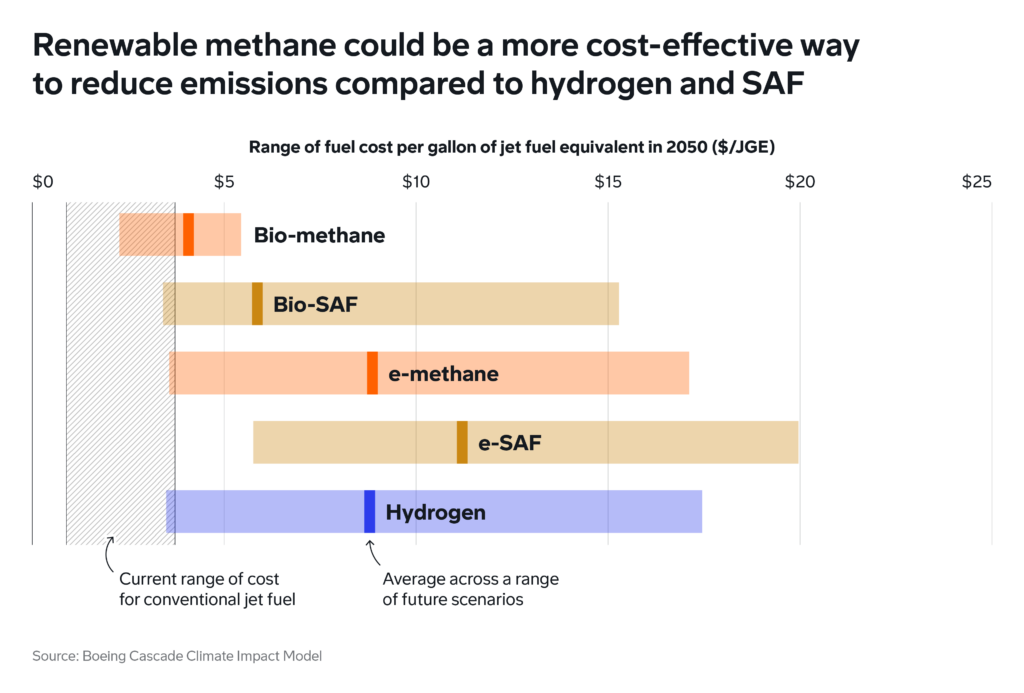
Methane also enables aviation to use many of the same feedstocks as SAF – like wastes and residues – at a considerably lower cost. This means methane could reduce emissions while making better use of limited resources and lowering the overall cost of decarbonization.
If aviation looks beyond drop-in fuels, the challenge is not just finding a viable fuel, but choosing the right long-term investment.
Both hydrogen and methane require major investment in new aircraft and infrastructure, so the strongest option needs to offer the best balance of efficiency, cost, and scalability.
Methane may be less widely discussed today, but its efficiency, infrastructure advantages and cost potential make it a compelling option for further exploration.
Investing in methane aircraft technology today will help establish the potential of methane and could unlock major opportunities for the second half of the century. To understand how methane fits in the broader aviation energy system, check out the explainer:
To understand how methane fits in the broader aviation energy system, check out the explainer: ‘What will power the future of aviation?’.

