

Methane and hydrogen are being explored as possible options to power aviation in the future.
While both offer the potential for lower lifecycle emissions than conventional jet fuel, they’re also greenhouse gases. That means they produce a warming effect in the atmosphere when they escape unburned from the supply chain.
The challenge is exacerbated by the fact that they’re cryogenic fuels: gases chilled to extremely low temperatures so they can be stored as liquids. Both hydrogen and methane would need to be used as cryogenic fuels to achieve energy densities for long haul flight. During production, transportation, storage, and fueling, some of the hydrogen or methane can escape into the atmosphere through leaks or venting. This loss of fuel across the supply chain is often referred to as fugitive emissions or vapor loss. For either hydrogen or methane to be viable, fugitive emissions must be minimized.
Fugitive emissions are a major climate issue
For renewable methane and renewable hydrogen to deliver their climate promise as aviation fuels, preventing fugitive emissions is essential.
When leaked as an unburned gas, hydrogen warms the atmosphere approximately 12 times more than CO2 over 100 years, while methane has a warming effect 30 times greater than CO2 over the same time period.
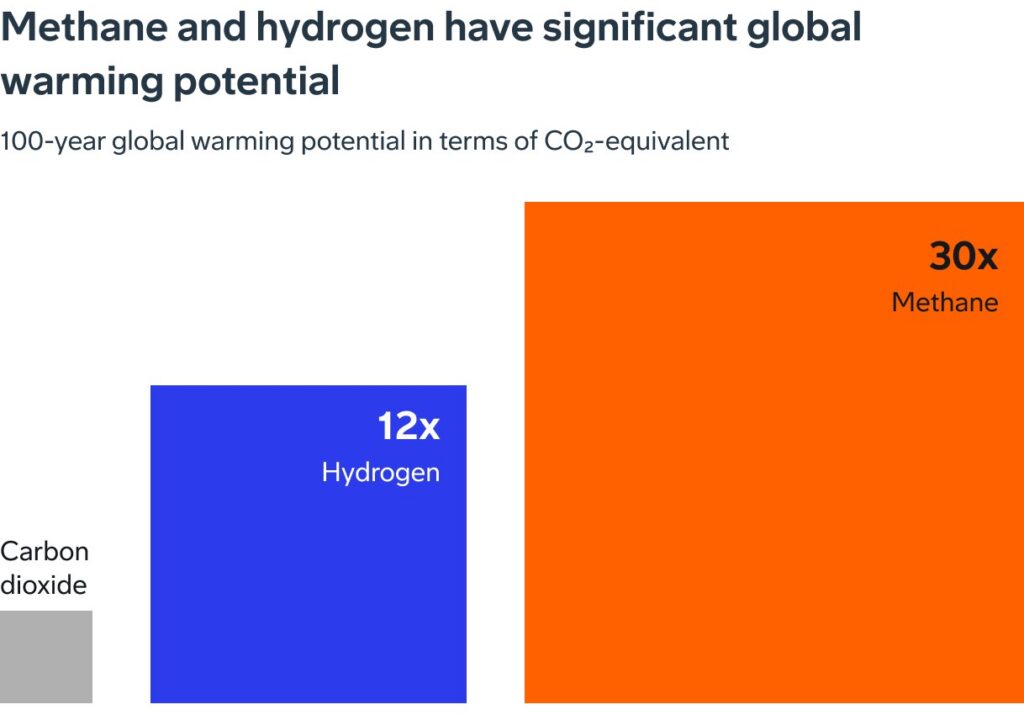
Source: Hydrogen GWP₁₀₀ of 11.6 from Sand et al., “A multi-model assessment of the global warming potential of hydrogen,” Communications Earth & Environment, 2023. Methane GWP₁₀₀ of 27.9 from Smith et al, “The Earth’s Energy Budget, Climate Feedbacks, and Climate Sensitivity Supplementary Material,” Contribution of Working Group I to the Sixth Assessment Report of the Intergovernmental Panel on Climate Change, 2021.
Rates of vapor loss vary dramatically between methane and hydrogen
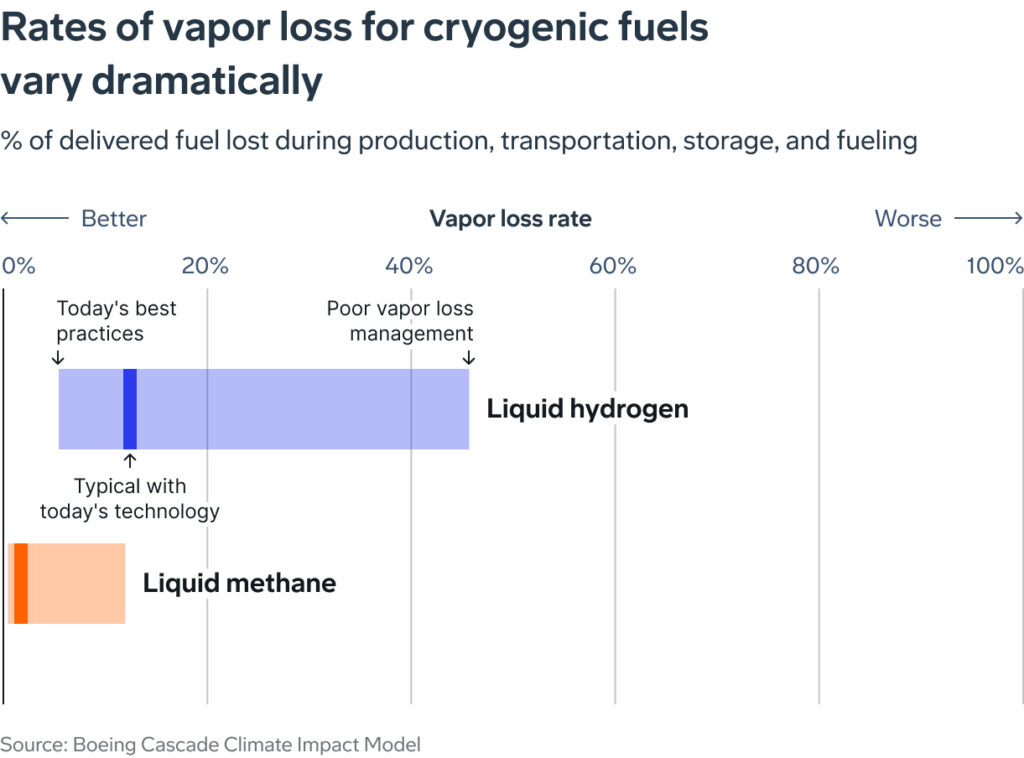
Beyond comparing global warming potentials, the level of vapor loss that occurs is crucial to determining the lifecycle impact of each fuel. Due to their vastly different temperatures, leakage rates between the two fuels widen dramatically in cryogenic form.
Liquid hydrogen must be stored at -253°C – just 20°C above the coldest temperature physically possible – and its molecules are small enough to seep through seals and materials that would contain other fuels. This makes preventing vapor loss a major engineering challenge.
Liquid methane – also known as LNG – is stored at -162°C, making it easier to manage and resulting in lower rates of vapor loss. It also benefits from mature LNG transportation infrastructure.
Vapor loss directly affects carbon intensity
Vapor loss rates can have a considerable impact on each fuel’s carbon intensity – a measure of the lifecycle emissions produced per unit of energy. This raises a key question: how much fuel can escape before the climate benefit disappears?
How much fuel can escape before the climate benefit disappears?
Adjust production carbon intensity and vapor loss rates to discover the overall carbon intensity of each fuel
Monitoring and accounting are essential when introducing new fuels
Mitigating fugitive emissions is already a major focus across the energy industry, creating an opportunity to reduce climate impacts in the near term. Through active monitoring, preventive measures, and leak detection and recovery systems, vapor loss can be kept to levels where the fuel provides considerable lifecycle emissions benefits relative to conventional jet fuel.
But limiting vapor loss is only part of the solution. Maintaining the emissions reduction benefits of cryogenic fuels will also require robust carbon accounting. Leading SAF certification schemes such as those used by CORSIA already include lifecycle accounting of fugitive emissions across fuel supply chains.
If aviation transitions to renewable methane or hydrogen, investments in limiting fugitive emissions and maintaining accounting systems will be critical to ensuring the environmental benefits are achieved.

